the breath you can always come back to
On Breath
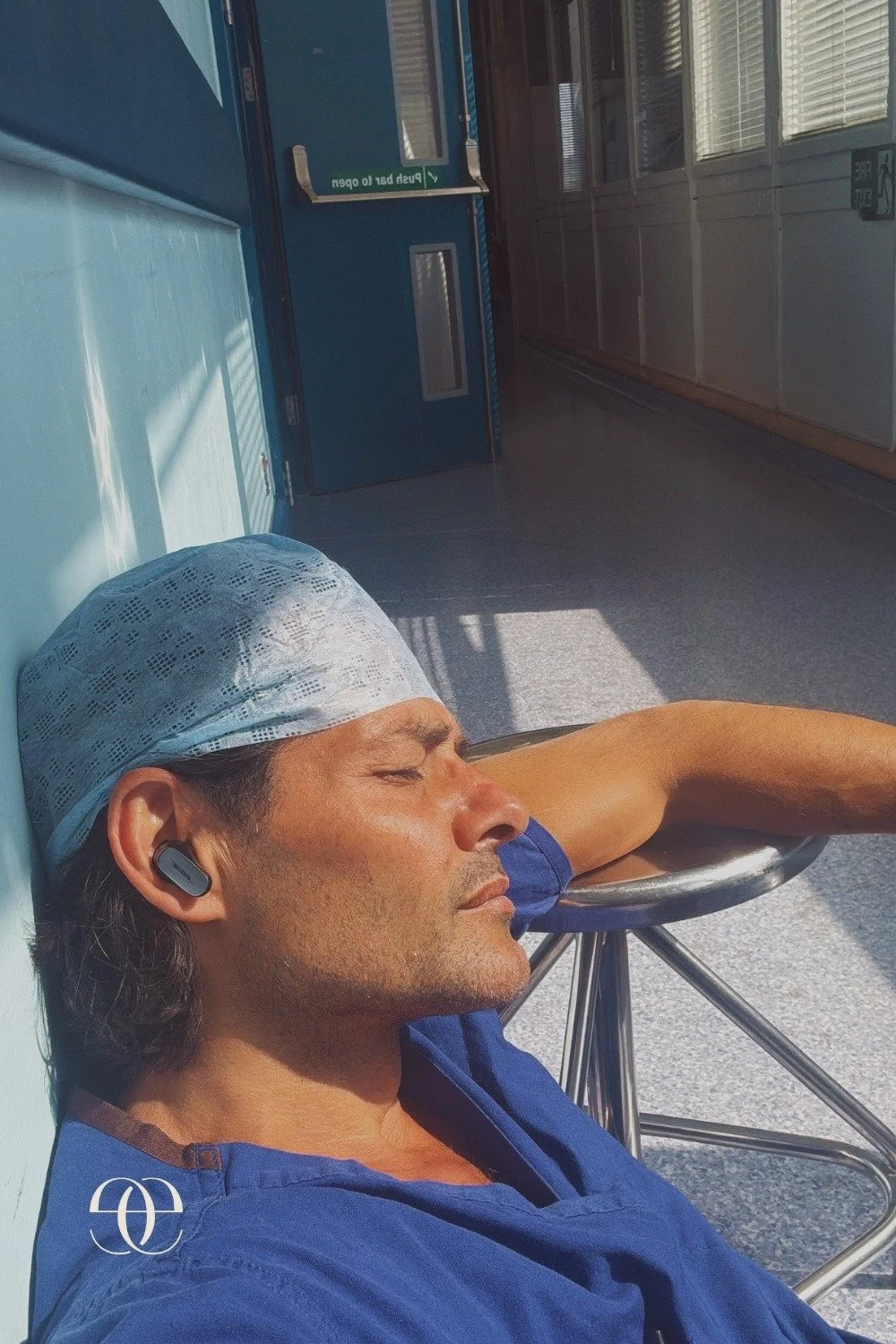
Dr Ali Esmaeili, plastic surgeon, resting with eyes closed in scrubs and a surgical cap in a sunlit hospital corridor between operations — a moment of breath and stillness.
you cannot always change the situation. you can almost always change the breath.
that is not mysticism. it is physiology.
your heartbeat, your blood pressure, your stress hormones — they run on their own. you cannot order them to slow down. but the breath is different. it happens by itself, and yet you can take it in your hands the moment you choose. it sits on the border between the automatic and the chosen. that makes it a door — the one way into systems you otherwise cannot reach.
and the key is the exhale.
breathe in, and the heart speeds up. breathe out, and it slows. so a long, slow out-breath does not just feel calming — it makes calm, tipping the body into its rest-and-repair state. this is measurable, not mood: slow breathing lifts the calming, parasympathetic side of the nervous system, and one simple pattern — a short breath in, a long breath out, repeated for five minutes — has been shown to lift mood and lower stress more than the same time spent sitting in meditation. five minutes. no app. no cushion. the body's own controls, used on purpose.
the square — how to do it
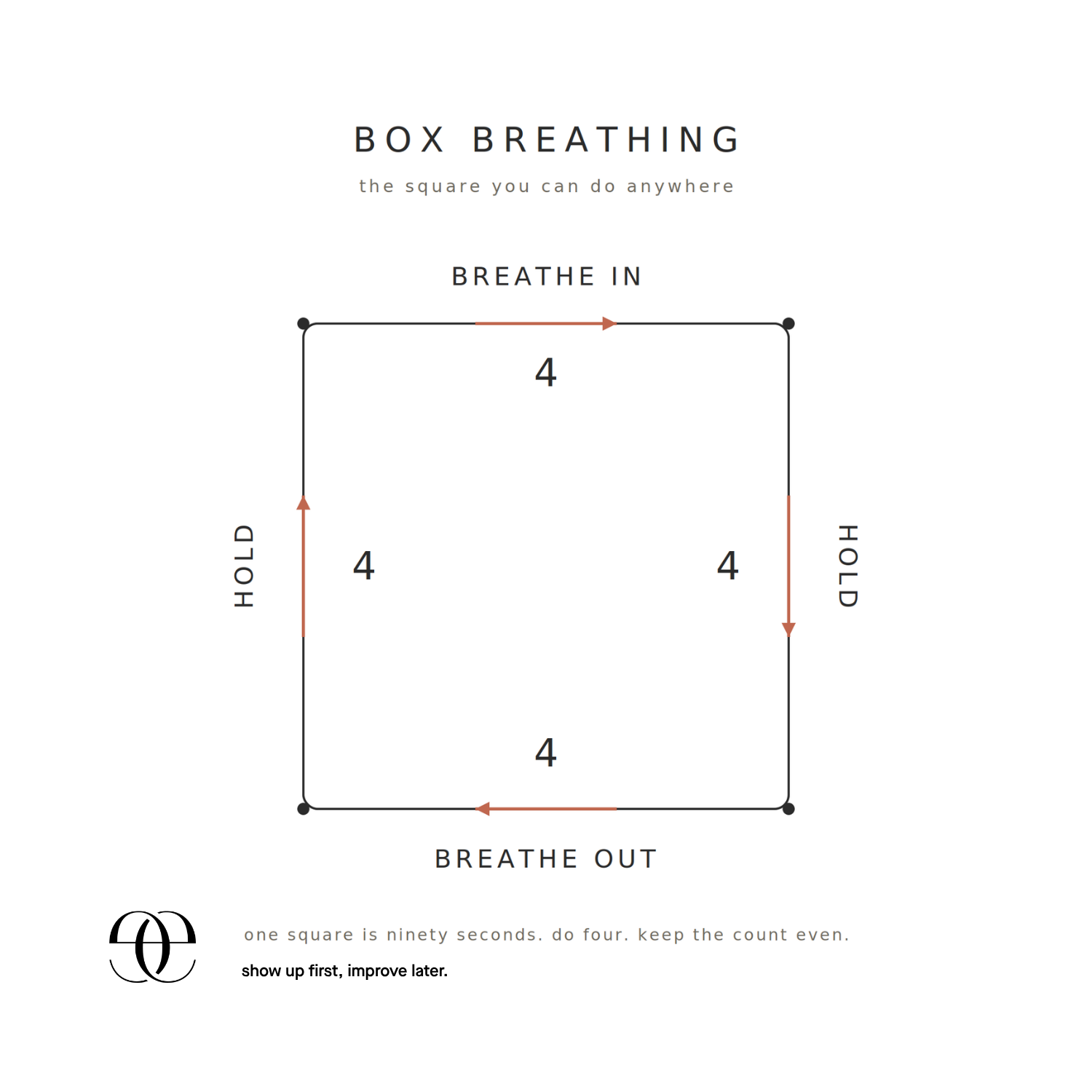
when i need it fast, i don't freestyle. i use a shape. it is called box breathing, or the square, and it is the one i teach because it is impossible to get wrong.
breathe in through the nose — count four.
hold — count four.
breathe out slowly through the mouth — count four.
hold — count four.
that is one square. do four or five of them. that is ninety seconds. you will feel your pulse come down inside the first two.
two rules make it work. keep the count even — in, hold, out, hold, all the same length. and if four feels like a strain, shorten it to three; if it feels easy, stretch to five or six. the number is yours. the shape stays the same.
five ways to use it
one tool, five moments. you don't need all of them — take the one that fits the day. this is yours to keep.
before something hard. the lift before the meeting, the door before the difficult conversation, the scrub sink before the cut. four squares. ninety seconds. you walk in with a slower pulse than you walked up with.
when panic rises. don't fight the fear — lengthen the exhale. breathe out longer than you breathe in, three or four times. you are not calming your mind; you are calming your body, and the mind follows.
to fall asleep. in the dark, drop the count long — in for four, out for six or eight. the long exhale is the off-switch. no screen, no supplement — just the breath getting slower than your thoughts.
to focus. before deep work, one minute of even breathing — in four, out four — clears the noise and settles attention on one thing. a reset button you carry everywhere.
as a daily rep. two minutes every morning, before the day takes you. not to fix anything — to practise, so the breath is trained and waiting when you actually need it. show up first, improve later.
the people who already use it
this is not a wellness trend. it is the quiet tool of people who perform under real pressure.
the special forces train it — box breathing is standard for staying clear-headed when everything is loud and fast; some units call it "tactical breathing." novak djokovic breathes deliberately between points, part of the mind training he credits for holding his nerve in the biggest moments of a match. free divers slow the breath to survive on a single lungful. actors do it in the wings. snipers do it before the shot. surgeons do it before the cut.
the common thread: high stakes, no room for a racing pulse, and a person who has learned to reach for the one lever that answers immediately. it is not soft. it is control.
i use it before i operate
the moment before the first cut is no place for a racing heart. so i breathe out, slow and long, and the hand settles with it.
i have watched the same breath calm a frightened patient, a nervous trainee, a tired version of myself at the end of a long list. it is the fastest medicine i know, and i can prescribe it as often as i like.
i have seen it work far beyond myself. a patient of mine, carrying a serious illness and the fear that rides with it, was overtaken by panic. i taught him the square — in for four, hold, out for four, hold — and asked him to use it whenever the fear rose. he did. it steadied him when little else could. he told me, later, that it gave him something to hold on to. that is the breath: the one tool always in the room, even when the news is hard.
why it is the one you come back to
you will forget your good intentions. you will miss your morning routine. the day will tear up your plan. but the breath is with you — in the lift, in the waiting room, in the hard conversation, at three in the morning. it asks for nothing. it is always there. when everything scatters, it is the thread back to yourself.
so i don't really ask people to meditate. i ask them to notice the breath, and to make the out-breath longer when the world speeds up. that is the whole practice. breathe in. let the breath out slowly, like setting something down. do it three or four times, and feel the body change its mind about the emergency.
we keep reaching for tools to feel calmer — the supplement, the device, the holiday. the most powerful one has been inside us all along. free. always with us. quietly waiting.
you don't have to fix your whole life to feel steadier in the next minute. you only have to breathe out, slowly, and come back.
— A Esmaeili
references
Zaccaro, A., et al. (2018). How breath-control can change your life: a systematic review on psycho-physiological correlates of slow breathing. Frontiers in Human Neuroscience, 12, 353. doi:10.3389/fnhum.2018.00353
Balban, M.Y., et al. (2023). Brief structured respiration practices enhance mood and reduce physiological arousal. Cell Reports Medicine, 4(1), 100895. doi:10.1016/j.xcrm.2022.100895
Russo, M.A., Santarelli, D.M., & O'Rourke, D. (2017). The physiological effects of slow breathing in the healthy human. Breathe, 13(4), 298–309. doi:10.1183/20734735.009817
Lehrer, P.M., & Gevirtz, R. (2014). Heart rate variability biofeedback: how and why does it work? Frontiers in Psychology, 5, 756. doi:10.3389/fpsyg.2014.00756
Ma, X., et al. (2017). The effect of diaphragmatic breathing on attention, negative affect and stress in healthy adults. Frontiers in Psychology, 8, 874. doi:10.3389/fpsyg.2017.00874