the steady hand: what surgery taught me about presence
On Presence
people think mindfulness is a mood. a candle. a cushion. something soft.
i learned it with a blade in my hand.
on the operating table there is no room for a wandering mind. the hand is only as steady as the attention behind it. if my mind drifts — to the last case, to an email, to fear — the hand drifts too. the body cannot hide it.
so you learn to gather your whole self into one point. to be here, in the tissue, in the next small movement, and nowhere else. that is all presence is: the whole of you, in one place, on purpose.
i can still remember the first time i noticed it. early on, a senior stood beside me, and my hands forgot what they knew. it was not the room. it was my mind, running ahead to what he might think, instead of resting on the wound in front of me. the moment i brought it back to the tissue, the hands came back too. the work is done here — not in the story about the work.
and here is the part that matters. you can train it.
attention is like a muscle. it tires. it strengthens. it grows with practice. the research agrees — even short mindfulness training reshapes the systems of attention, sharpening focus and the ability to notice when focus slips. i felt it before i read it. the young surgeon's mind darts. the older one's rests, quiet and heavy, on the task. that stillness was earned, one operation at a time.
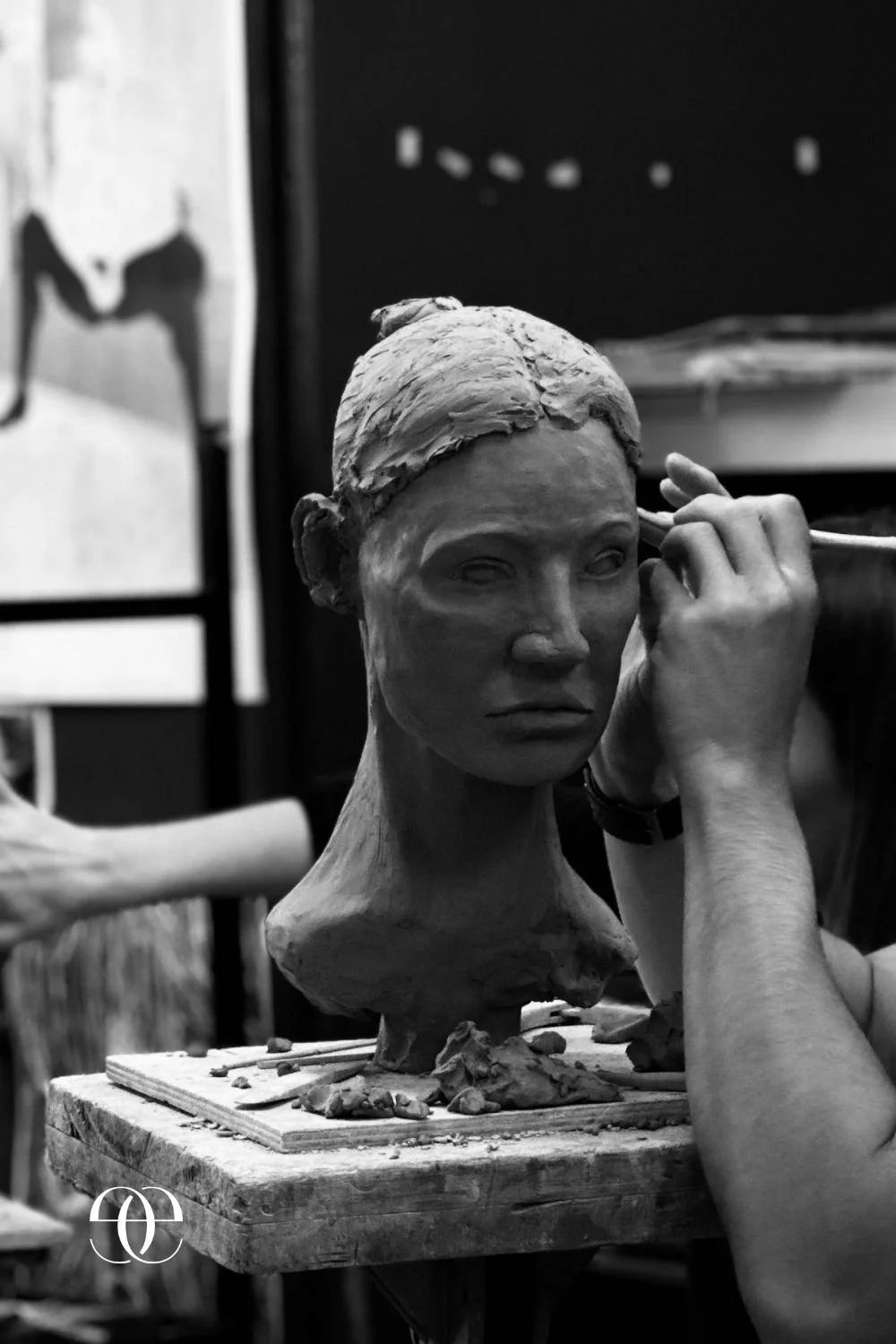
i see it away from the table too. i sculpt — clay, a face, a tool in my hand — and the hours vanish, because there is no room for anything but the next small press of the thumb. it is the same muscle. the surgeon and the sculptor are, in this one way, the same man: entirely inside the thing they are making.
and this is the part we have lost.
we live now in a world built to break our attention. a buzz, a screen, a notification — each a small tug, pulling the mind out of the room. we have never been more informed and less present. a scattered mind is not a small thing. it is a life half-lived — always somewhere else, never quite here.
but presence reaches far beyond the table. the same attention that steadies a hand steadies a life. the conversation you are fully in. the meal you actually taste. the person who feels, for once, that they have all of you — the rarest gift one person can give another. we have made attention scarce. to give it fully is a kind of love.
so i don't practise presence to escape my life. i practise it to be more inside it.
and you don't need a cushion. the morning run is presence — body, breath, path, nothing else. the first coffee, tasted slowly. the unhurried hour. even washing your hands before a case, feeling the warm water, is a way of gathering yourself before the work. these are not rituals. they are reps.
the steadiest people i know are not calm by nature. they trained their attention until it held. it is the quiet skill under all the others — because you cannot eat well, move well, sleep well, or love well with your mind somewhere else. presence is the ground the other pillars stand on.
the hand is steady because the mind is. the mind is steady because, for years, you asked it to be.
begin anywhere. the breath. the run. the cup of coffee. be, completely, in one thing. then the next. the steadiness comes.
— A Esmaeili
references
Jha, A.P., Krompinger, J., & Baime, M.J. (2007). Mindfulness training modifies subsystems of attention. Cognitive, Affective, & Behavioral Neuroscience, 7(2), 109–119. doi:10.3758/CABN.7.2.109
MacLean, K.A., et al. (2010). Intensive meditation training improves perceptual discrimination and sustained attention. Psychological Science, 21(6), 829–839. doi:10.1177/0956797610371339
Mrazek, M.D., et al. (2013). Mindfulness training improves working memory capacity and GRE performance while reducing mind wandering. Psychological Science, 24(5), 776–781. doi:10.1177/0956797612459659
Killingsworth, M.A., & Gilbert, D.T. (2010). A wandering mind is an unhappy mind. Science, 330(6006), 932. doi:10.1126/science.1192439
Ophir, E., Nass, C., & Wagner, A.D. (2009). Cognitive control in media multitaskers. PNAS, 106(37), 15583–15587. doi:10.1073/pnas.0903620106